

When viewing pictures of our Belgian apartment online, I had wondered: is that tall, slim gray thing actually our refrigerator? It looked like a broom closet! How could there be enough room in a glorified dormitory fridge to store food for our family of four?
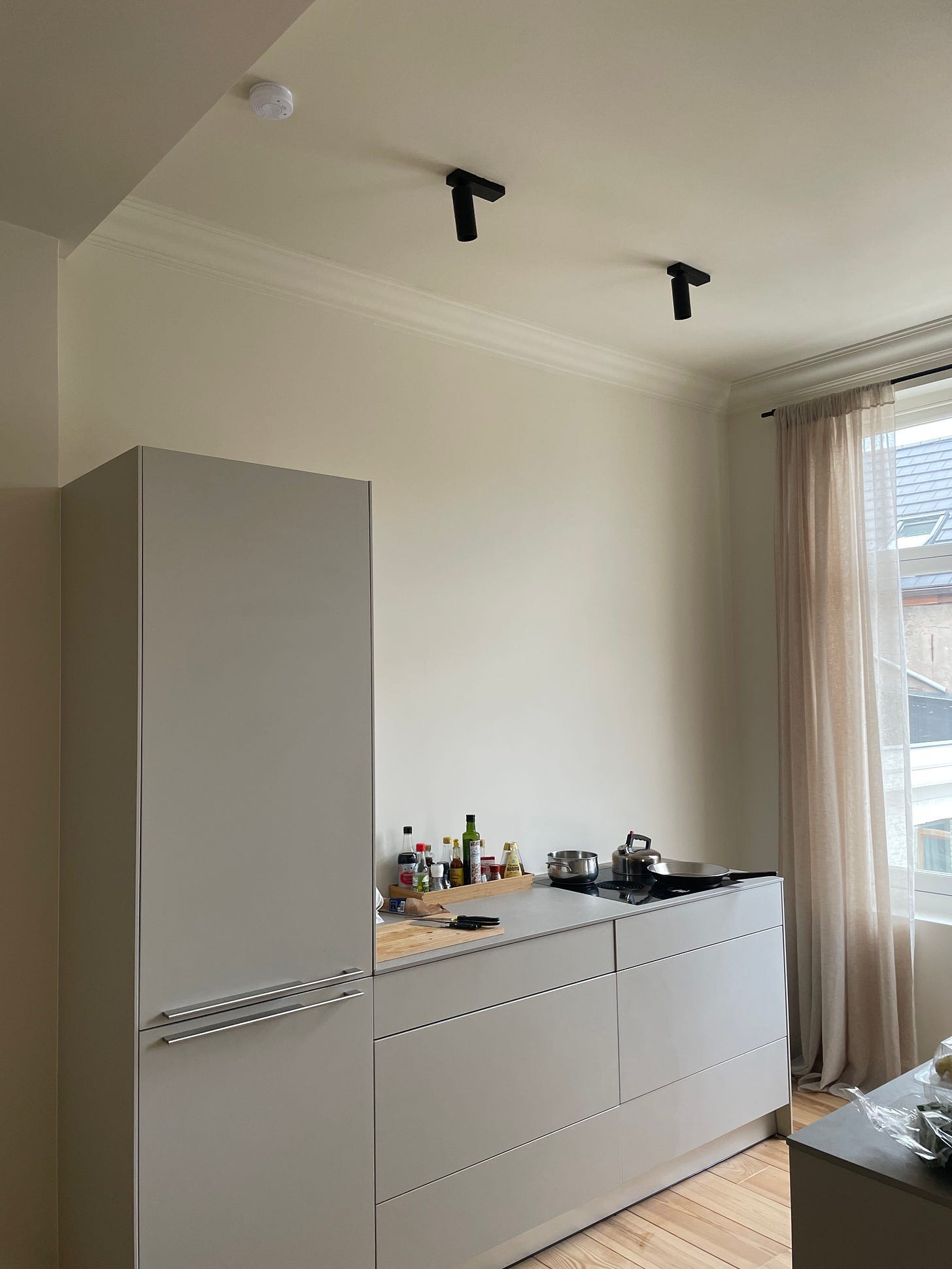
Back home in Charleston, South Carolina, we have an average-size American refrigerator. Many of my friends have bigger ones. My parents have two refrigerators. The extra one is a holdover from their days when they had a full house. But after a Costco trip, those shelves fill, too. I am from the land of big fridges! Lots of fridges! How would we manage abroad?
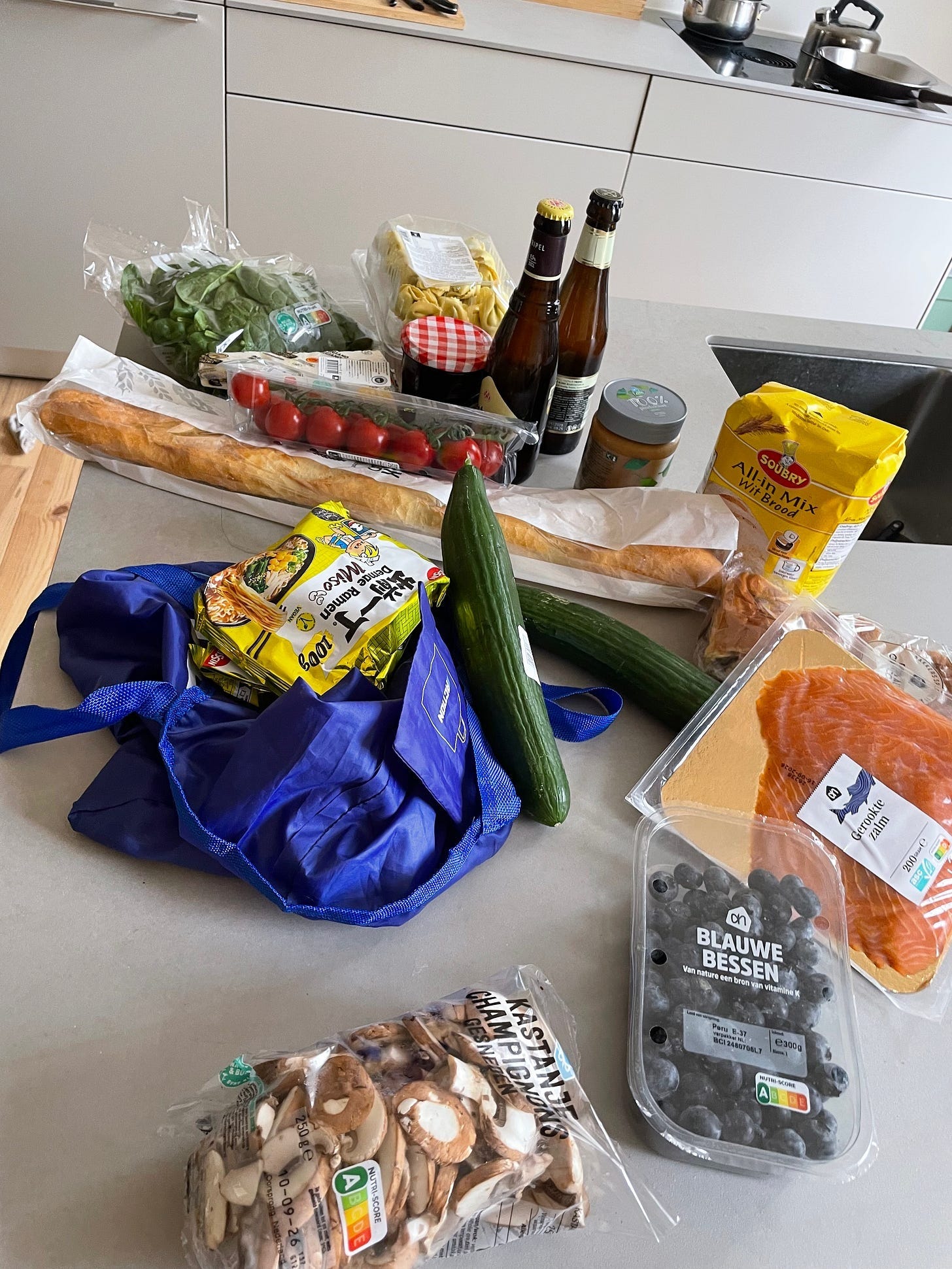
Turns out, our fridge in Ghent is both small and has plenty of space. Not because our eating habits have changed (though, I will say the quality of food in Belgium is noticeably higher. For starters, I have yet to spy any bizarrely large apples.) The difference is—in Ghent—we shop more frequently, but we buy fewer items each trip. My grocery list is short; I go to the store every two-to-three days.
I think this has to do with the way the town is set up. By intentional design, the city of Ghent wants you to walk, bike, or take public transit. The medieval town squares that became parking lots were returned to being town squares. Driving is allowed, but inconvenient. Therefore, most of the people pouring in and out of the stores in the city center are entering from the street, not a parking lot.
A lot of these grocery stores are underground, beneath old stone buildings, and they’re all about the size of a Trader Joe’s (which I like). At the entrance are stacks of little blue bins on wheels, which make it easy to dart around the store quickly. People breeze through the aisles, buying a dozen items or so, and quickly pop out into the lively street to return home on foot or by bike.
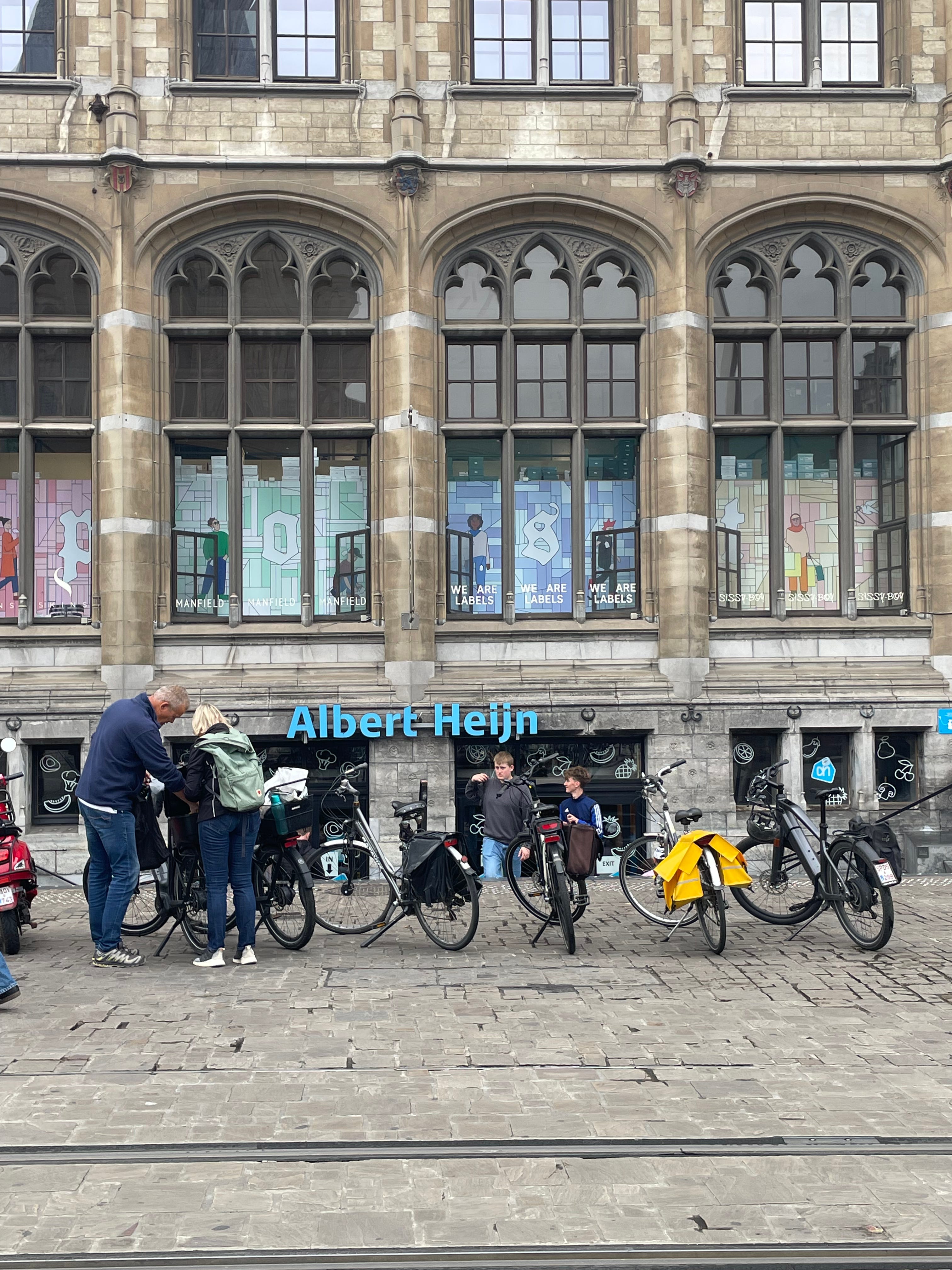
Recently, after weeks of living here, I encountered my first metal grocery carts (similar to ours back home) in the Albert Heijn. The two women pushing them took up the whole aisle. I couldn’t nimbly reach around them or scoot between them to grab the hummus, so I had to walk backwards and wait so they could roll past. It wasn’t a huge inconvenience, but after a dozen trips without having to slow down at all, the aisle-blocking was noticeable.
Could there be a simple mobility metaphor here? That the grocery carts are the cars, and the little blue baskets are the pedestrians and bikers? When we travel smaller, it seems to me, there’s better flow. Movement is more efficient for everyone when we take up less space.
In fact, my posts all seem to be boiling down to that one idea: space.
We have more space in America: more space for big grocery carts, big grocery hauls, and big fridges. That space conditioned me to certain buying habits.
Our neighborhood store back in Charleston is Food Lion. To put it gently, shopping at Food Lion is not a pleasure. There lighting is harsh, the floors are dingy, and there are often long lines. For a long time, I called the Food Lion the Shitty Kitty. But this neighborhood grocery store also sells kombucha, and I’ll be darned if the avocado selection isn’t better than the one at Harris Teeter. So when my friend suggested I call it the Kitty, I made the switch.
A typical trip to the Kitty involved me buying a weeks’ worth of groceries. Then I’d wheel my big metal grocery cart over to my car or cargo bike, load it up with stuffed bags, ride home, lug my bags into the kitchen, and then unpack all the groceries. I’d place my new yogurt next to the old one. I stack cheddar cheese like building blocks and shove a bag of kale next to an open one with leaves starting to turn slimy. I have bought extras of everything to prolong the time before I have to go back to the Kitty, shitty or not.
And the worst? After all that effort, I usually realize I forgot to put oat milk (or sandwich bread, or whatever) on the list. After all that effort, I don’t have what I want. Ugh. It suuuuuucks going back to the store. It’s so much work! But here in Ghent, grabbing one item is no biggie. Popping into the store is a breeze.
So is writing my grocery list: I know exactly what I need because my fridge and pantry are so parsed down that it’s easy to see what’s missing. This, at least for me, makes shopping a pleasure.
There seem to be other benefits to shopping frequently, too. First, we have little-to-no food waste in Ghent. Back home, where my fridge is fully stocked for the week, I need to revive the celery stalks in a glass of water, compost the slimy kale, and on rare occasion and with a heavy heart, toss expired meat. The bottom half of the freezer is a food time capsule, holding sub-par spanakopita that never got used for our holiday party two years ago and a bag of mixed berries that morphed into a block of purple ice. Is your fridge like this, too? On average, Americans throw away about 40% of their groceries. That’s a lot of wasted food. Could this statistic be tied to our bulk buying?
Second, I enjoy the new foods more often. Who doesn’t love pawing at a fresh carton of blueberries? But when that same fruit has been lurking in my fridge for four days, even when the blueberry carton is unopened, they’re not as appealing. Fresh food is better. And when you shop more frequently, you get it fresh more often.
I am guessing that Americans living in big cities like New York and San Francisco might have shopping habits similar to mine in Ghent, with the density supporting more stores. But Ghent doesn’t have sky scrapers. This town is wonderfully human-scale, like Charleston.
So, as we think about the future shape of our city, do we engineer the transportation of the Holy City around grocery shopping? I doubt that’s the answer. But I do think it’s a real part of the equation.
Why? Here is what I have learned while living in Ghent: physical movement through space affects us mentally. Going to work or the gym, to drop your child off at school or to pick up groceries… all of these everyday errands that fill up our days can be a sources of joy or stress. It’s up to us to decide which. The shape of the city shapes our lives. Design dictates our experience.
So, who dictates design? I believe it’s up to us, the people. You and me. We should think carefully about the way we want to move through our city, including how we want to grocery shop, and including my buddies in the ‘burbs! As our city evolves, we must be clear about what we want, whatever that is. Because if we don’t put what we want on the list, the thing we want gets forgotten.
You have me thinking about all the big SUVs in the regular-sized lanes and parking spots in Charlotte.
Also, the new yogurt next to the old yogurt hit close to home ;-)
When I lived in Cambridge, MA, and walked or biked to work everyday (we had 1 car, rarely needed), I’d stop by the corner grocery on the way home to pick up one or 2 items for dinner. Our kitchen was roughly the size of a bathroom in our home now — compact, efficient, and as you say, it worked, beautifully. Space in America feels synonymous with greed. Currently every small house in our Mt P neighborhood is being plowed down for some larger, often uglier, new build.