

When I first arrived in Ghent, I behaved like a tourist. My head swiveled to absorb the beauty of the step-gabled houses. Slack-jawed, I gulped in the view of ancient canals reflecting the cottony clouds above. My ankles wobbled on the cobblestone streets as I followed my nose to an outdoor restaurant serving Belgian’s famous french fries.
Back in the 1900s, someone might have called me a “jay.” That was the term used by American city slickers to describe unsophisticated rubes from the country awed by their new surroundings.
While we’re back in the 1900s, let’s stay there a bit. It’s a time when the streets in the US were still thought of as public spaces—where children played, vendors sold wares from pushcarts, and streetcar riders hopped off the trolley to walk home. People zigged to the pharmacy and zagged to their friends’ houses. Streets were places to congregate, connect, and cruise from one place to the next.
But then the cars arrived, and a battle for space ensued. A bloody battle.
People were being struck and killed by automobiles at alarming rates, particularly children. Initially, the public blamed the automobile. But then, lickety-split, the narrative flipped. In a matter of years, the blame was placed squarely on the pedestrians.
Why? And how?
In light of the many maimings and deaths, car manufacturers and others who profited from the proliferation of the automobile needed to win over the American public. They needed both to reduce deaths and to also claim the streets for cars. They needed people out of the way, crossing the street only at designated intersections. They needed to convince Americans that streets were no longer a place for children to play and for people to connect. To do that, they had to change the culture.
Remember that slang word “jay” at the top of this article? As you might guess, the term “jaylwaker” is related. Initially, “jaywalker” was an obscure term, but then the automobile advocates learned that using the shame-laden word was an extremely effective tool to shift behavior. By appealing to a person’s deep desire to avoid shame, automobile advocates convinced the American public that it wasn’t that cars were dangerous, it’s that the pedestrians who got hit by them were idiots.
Check out the ad below as one example. This image comes from the fantastic article by Peter D. Norton: “Street Rivals: Jaywalking and the Invention of the Motor Age Street.”
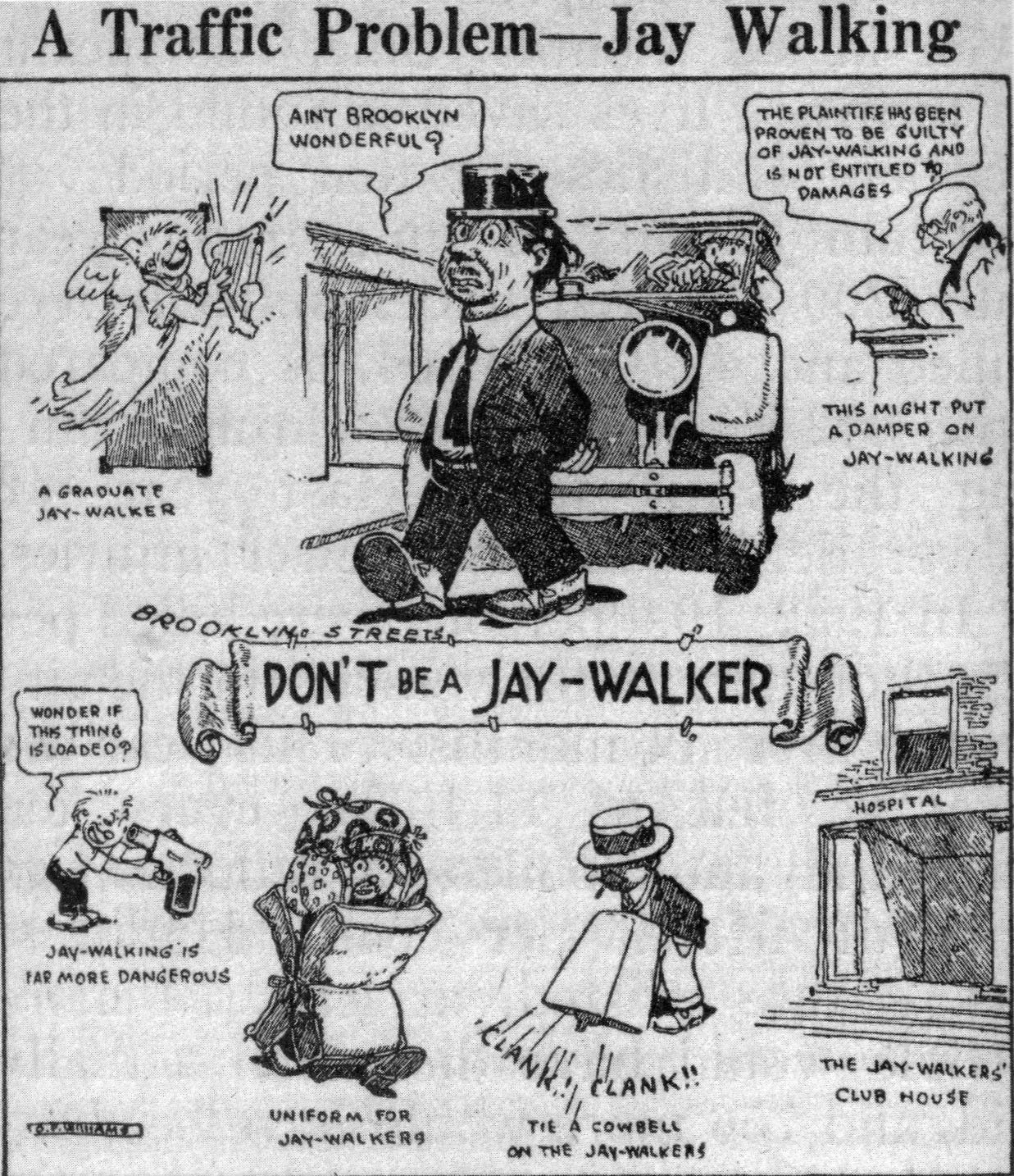
Take a close look at that big guy in the center. He looks goofy. Dumb. Ugly. And maybe deserving of his impending crash with the automobile?
And the dialogue box above his head suggests he’s a newcomer to Brooklyn. So, that would make him a tourist. A “jay.” It would make him someone like me when I first arrived in Ghent and also like the thousands of visitors who come to Charleston every day—someone naive to their new surroundings. Someone in a different head-space. Someone awed.
When I have conversations about pedestrian safety back in the States, I hear echoes of this 100-year-old campaign, even from elected officials. They say something like, “yes, pedestrian safety is a problem! We need to teach pedestrians, especially tourists, how to be more careful.”
This absolutely baffles me.
First of all, could it be we’re going after the wrong population? When we target pedestrians to carry the burden of safety, it’s like telling a kid at the school cafeteria to wear a poncho, because there’s yet another food fight, and while it’s messy and no one likes jello pudding in their hair, food-throwing kids will be food-throwing-kids. What can you do? Or, it’s like telling runners to wear poop-proof shoes, because people no longer have to pick up after their dogs. Or blaming women for sexual assault because they dressed too alluringly.
Charleston’s Heads Up! campaign feels equally ridiculous.
The campaign, launched in 2023, was supposed to make the city “much safer” for people outside of cars. While I am glad for any efforts to make pedestrians and cyclists safer, the guiding principles of the campaign seem very much rooted in the jaywalking mentality concocted a century ago. When I first encountered the campaign signs in the city, the only ones I saw were the ones directed at pedestrians, encouraging us to use the crosswalk, look up from our phones, and maybe even lift a hat off our head to be more visible. For realz! (See red sign in photo below).
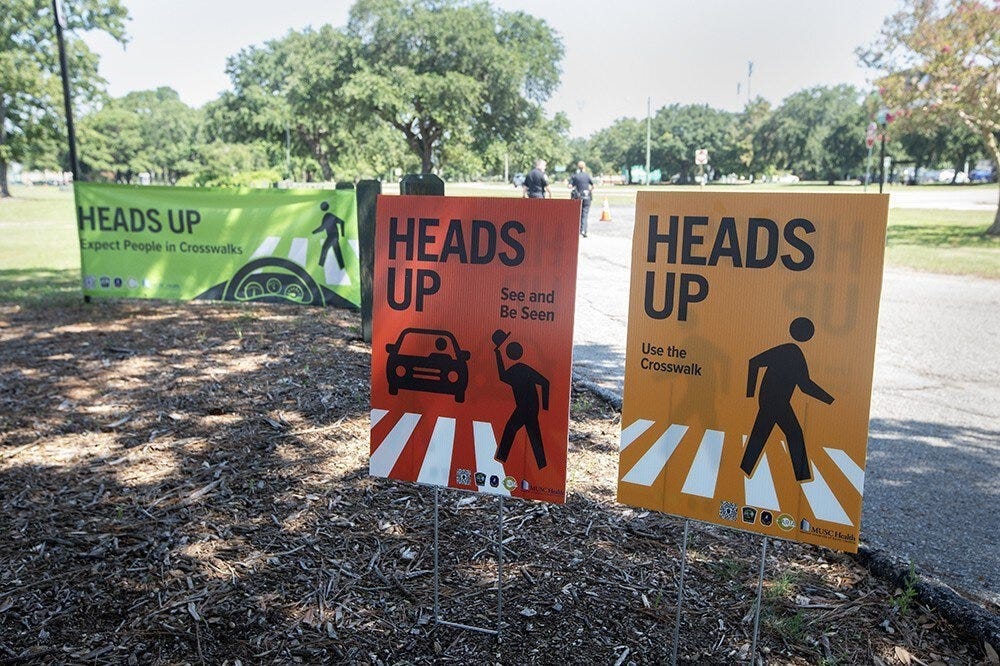
When researching the campaign, I did see there were initiatives to reach out to the drivers as well. The green sign on the left of the photo above is directed at that population. It reminds drivers to “expect people in crosswalks.”
Um. Yes. For heavens’ sake, please expect people in crosswalks! Isn’t that the bare minimum a driver can do?
This whole Heads-Up! Campaign is a head-scratcher.
Here’s another puzzling aspect of this campaign: over and over again, studies show that signs don’t really work. Mostly, they’re ignored by drivers, and if drivers do notice the signs, soon they habituate to the image and drive just like they used to. And, according to Smart Growth America, Charleston’s streets remain among the deadliest in the nation, and they’re getting worse, not “much safer.”
But, you might say, I saw the Heads Up article and learned that nearly half of all incidents of bike and pedestrian collisions with automobiles were at fault of the person outside the car. Legally, I’m sure that’s true. But could at least one of the collisions where the pedestrian is at fault be attributed to the scenario sketched below?
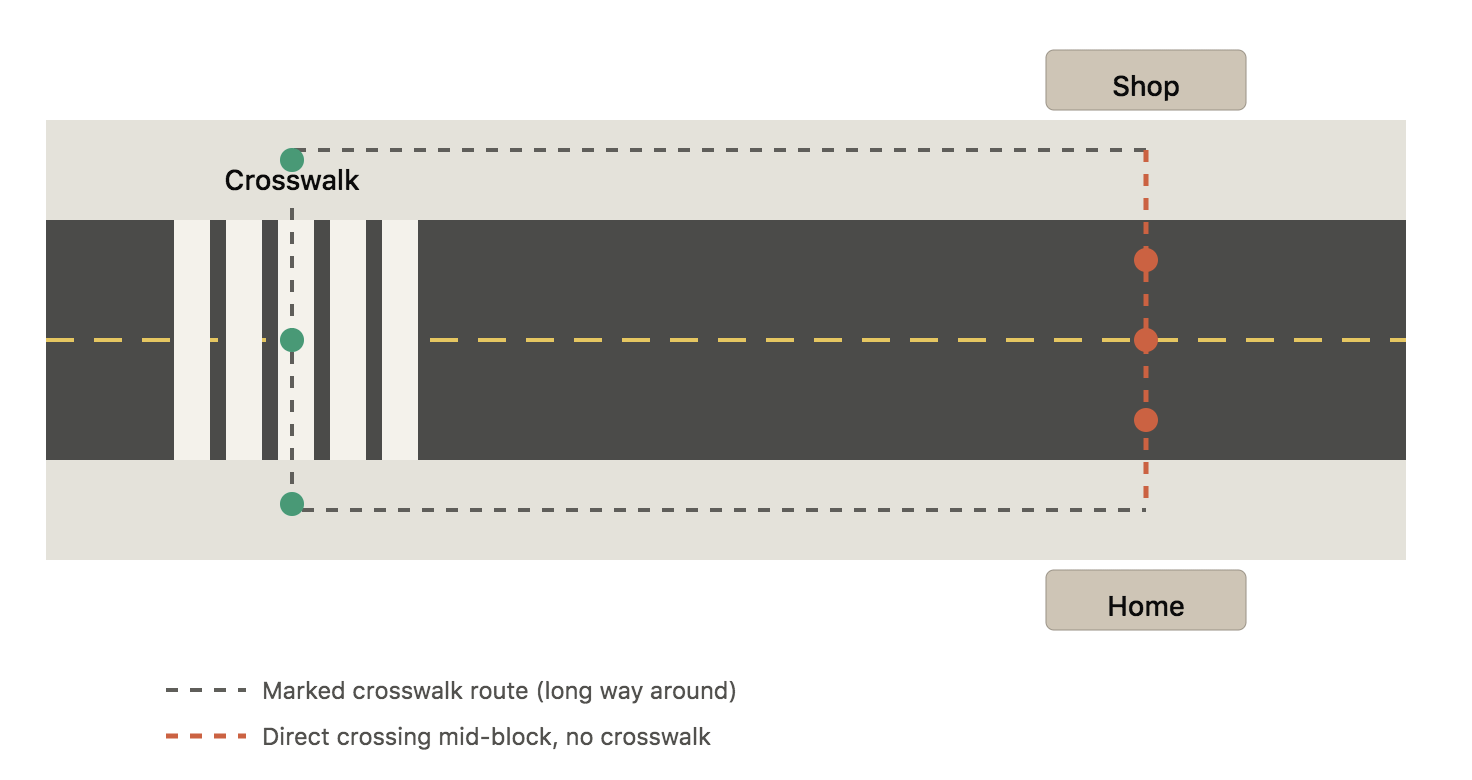
In AI generated diagram above, the desired path of the pedestrian is the redline, and the legal path is the green one. Have you ever darted across the street because it felt absurd to walk so far out of your way to a crosswalk just to get to the other side?
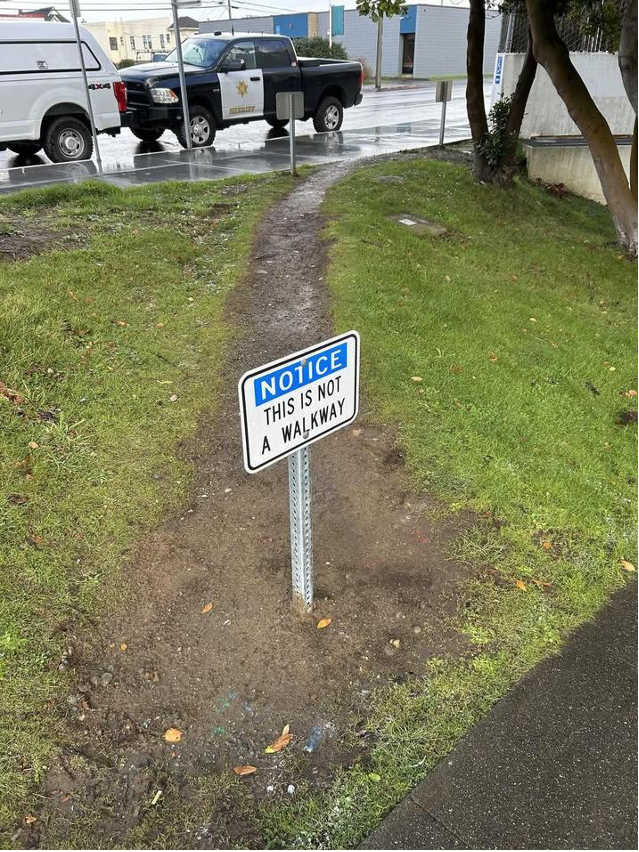
I have. And other people do it, too. When it comes to a pedestrian’s route, could at least some of the blame be placed on the city’s design?
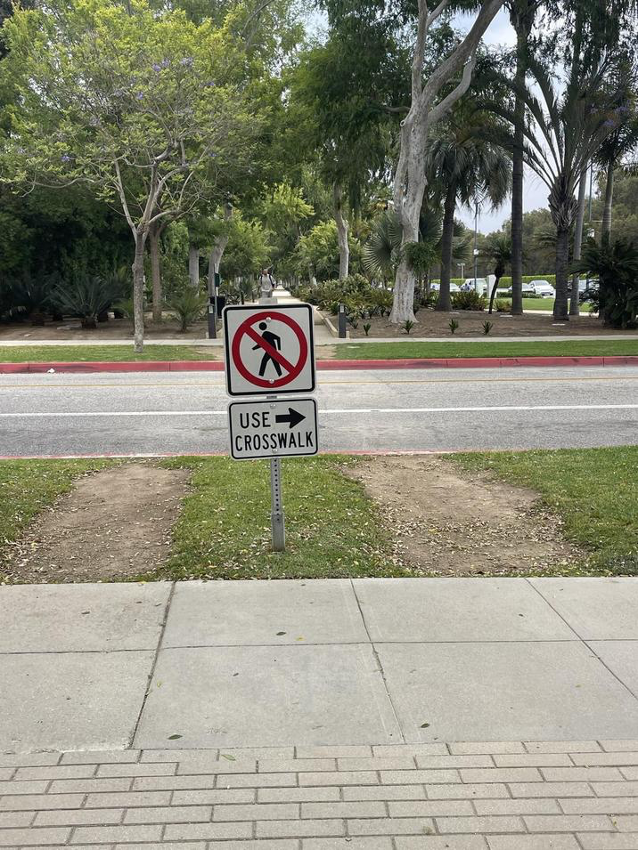
And let’s get back to those darned jawalking tourists, the ones who must be educated about road safety. Can you really inform every newcomer of the city’s rules? Is this really and truly a feasible objective? Perhaps the Charleston Visitor’s Bureau should slap neon stickers on those colorful maps of the peninsula, warning Charleston tourists: “Don’t look down at this map, you fool! Look up or you’ll be flattened! Look up! Look up!!”
Tour guides are in an especially tricky situation. One pointed out to me that to legally cross the street when she’s on the High Battery, her options are limited. She either has to double back all the way to the crosswalk at Hazel Parker Playground or to round the corner and cross the street once she reaches Murray Boulevard. Why do she and our economy-boosting tourists need to do the extra walking when the cruising pickup truck gets full reign of the road?
My initial thought was, well, we could fix that with more crosswalks. But now that I’ve been in Ghent for a month, I’m not sure sure. Maybe we don’t need any! Check out the video below to see the main intersection in the heart of Ghent. Y’all, thousands of people roam this spot daily, and there are no crosswalks, no stop signs, and not even traffic lights.
It’s a wildly different urban landscape, and yet—even without a city-wide campaign to teach newbies like me how to navigate the streets—it somehow all works.
How? I think it’s due to a recent cultural shift. In 2017, Ghent implemented a circulation plan that forced shared use of the streets so that today this European city looks a lot like how Charleston did in in the early 1900s. Nowadays, people who walk Ghent’s streets aren’t considered jawalkers, they’re just people being people.
Humans aren’t that different across time and space. Whether we’re a country bumpkin from the last century or a jet-setter landing in Belgium for the first time, we are awed by new surroundings, and—despite what the signs say—we generally prefer walking the shortest distance from where we are to where we want to be.
So, instead of trying to train social behavior around the automobile, perhaps Charleston can go back to the way our city once was: organically designed around the human.
Taking back space in the streets is not a new idea. Time and time again, research shows happy, vibrant, and economically sound cities put people first, so it makes me wonder, when it comes to how we think about Charleston’s future and our continued deference to the primacy of the automobile, who are the real jays?
Loving these insights and reports! I did some research for a tour with Charleston Moves a few years back about civil rights and transportation. I need to find my notes and share the primary docs with you 📖
That main intersection reminds me of the Naked Streets movement. Imagine if Meeting and Calhoun had no signage, no traffic lights, no crosswalks. It would *really* force the drivers to slow down and pay attention.