

While my husband is no sports fanatic, he really wanted to experience a European soccer match. So, we purchased tickets to watch Ghent take on it’s rival, Brugge.

We don’t have a car in Belgium. We haven’t needed one; the public transit in Ghent is fantastic, where you can get to just about anywhere and arrive on time. Like, down to the minute on time.
The tram line for this particular journey ended about a half mile from the Planet Group area, where the match was being held. If it were just me and Anthony, that walk wouldn’t be a problem, but because our kids were already cranky, we opted for a chartered bus organized by the Klijke Atletiek Associatie (the Royal Athletics Association) that would pick us up near the city’s center and drop us off right at the arena.
We had to wait a bit in the rain (it drizzles often here, and without much warning) for the bus to arrive. During that time, we had a chat with a fan of the opposing team. While we had some issues with the language barrier, I fully understood what he wanted me to know: he was not “a hooligan.”
A hooligan?
Before I had time to clarify, our bus arrived. It was clean and comfortable and its destination clearly marked. Nice, but not eye-popping.
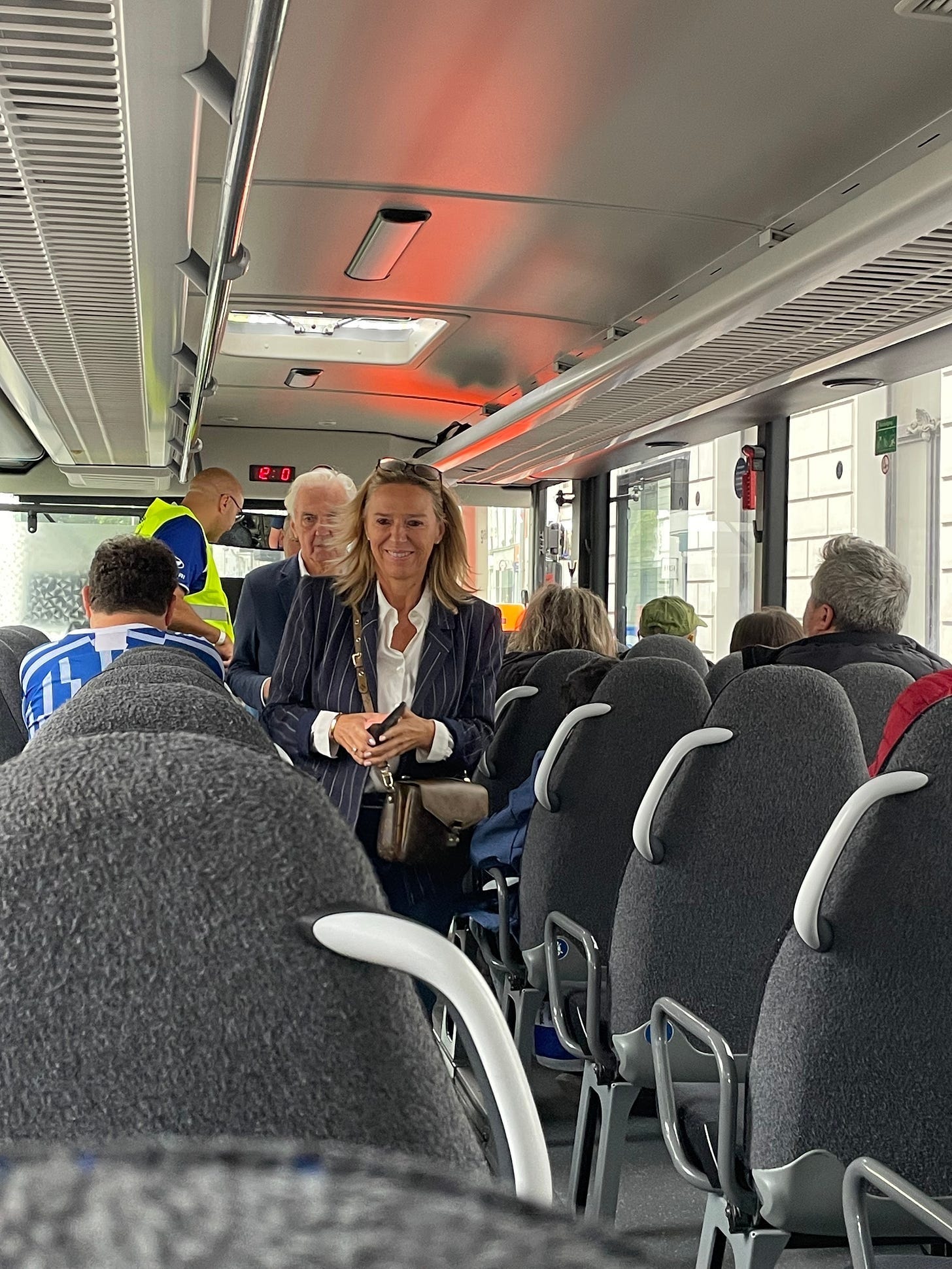
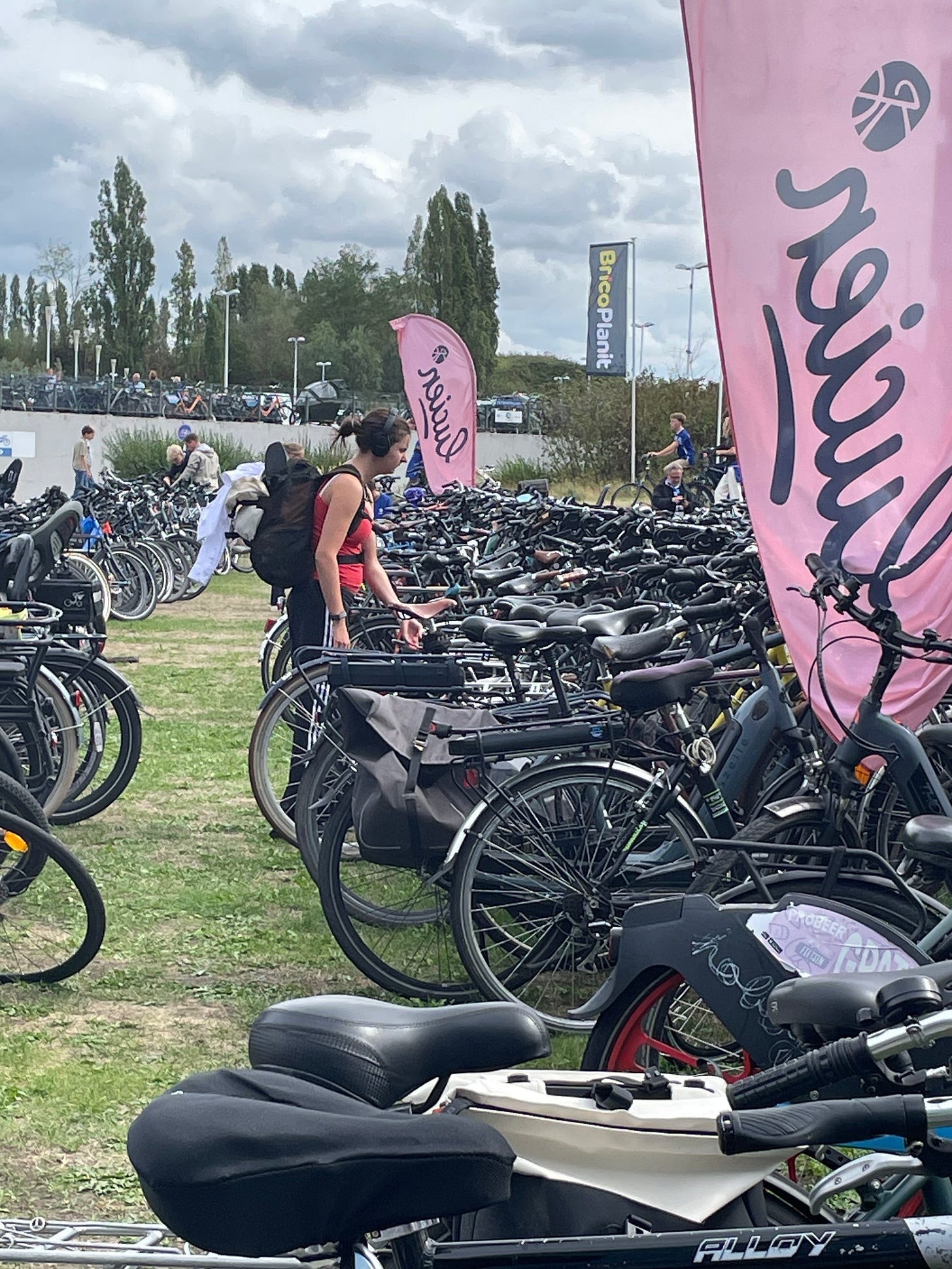
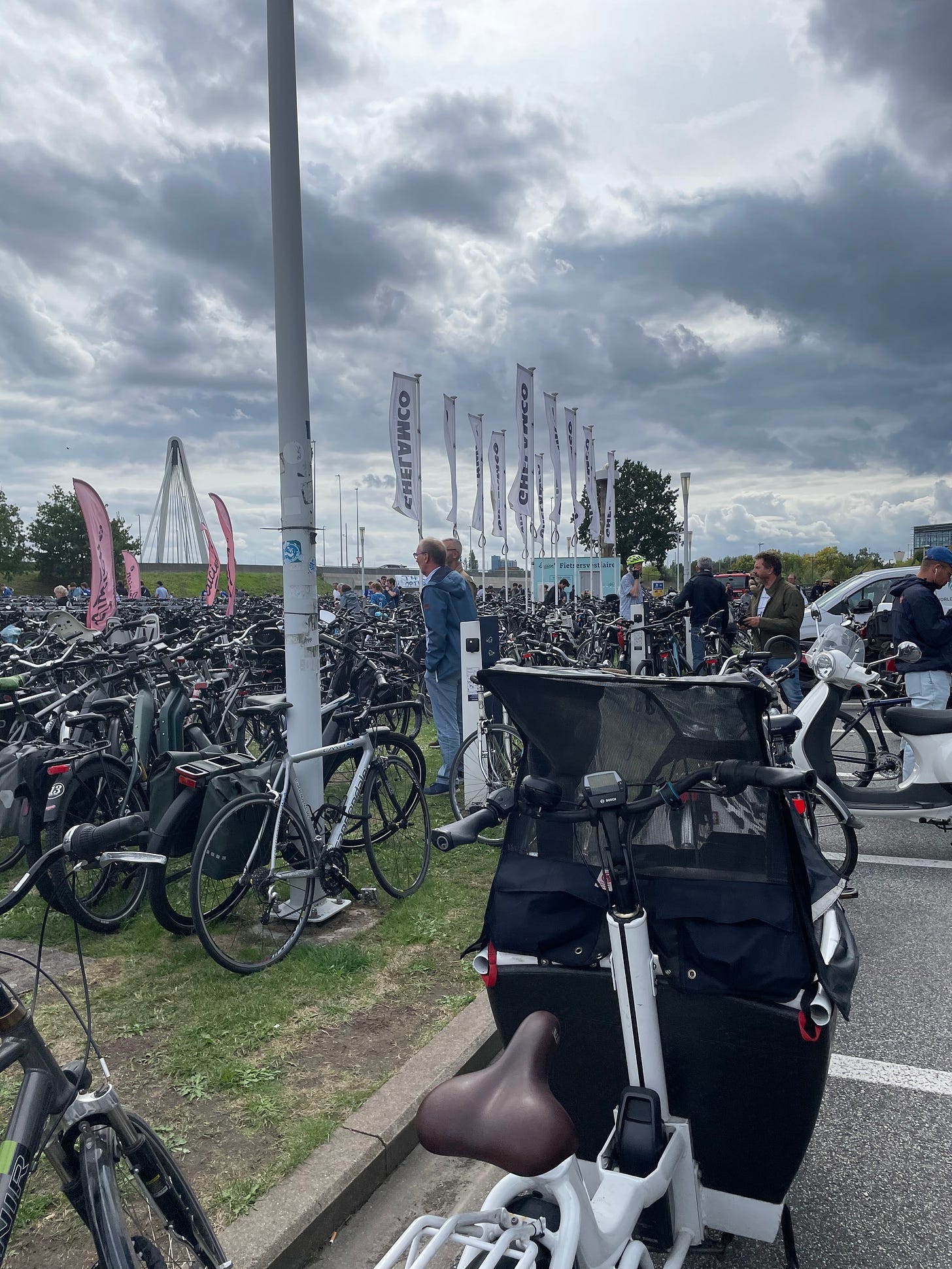
So, what had me pressing my face against the glass, breathing hot air onto the bus’s window? It was the absolutely foreign (to me) scene that materialized as we inched closer to the arena.
Bikes! Hundreds of bikes! Thousands! Fans funneled in from across the city, masses of them on two wheels. I had never seen anything like it.
I hope you take a moment to watch the video above. Can you see the line of cars in front of us? While my videography didn’t capture the droves of bicycles anywhere near their peak, it can show the efficiency (or lack thereof) of two different modes of transportation. Because bikes are smaller and nimbler, cyclists can weave around each other at varying speeds while keeping the flow steady. So, when the biker in front slows or stops, it’s easy for the faster ones coming up from behind to scoot around it. (And, by the look of their body language, have fun doing it).
Vehicles don’t have this agility. When the road is congested, there is little extra room for cars to maneuver. They’re stuck. Because we were in a big honkn’ bus, we were stuck, too. In fact, even though we’d set out with plenty of time, we were getting dangerously close to missing the start of the game.
Thankfully, all those bikes meant fewer cars on the road, which meant less traffic for the rest of us. We eventually arrived with minutes to spare.
After some confusion about which gate to enter, we made it to our seats just before kick-off. We had a great view of the pitch, but my attention was immediately drawn to the plexiglass wall running the length of the stands next to me. What was that for? And who were all of those rowdy folks in black, banging on drums and chanting on the other side of the partition?
Oh. Right. The hooligans.
The fans of the opposing team from Brugge were intense. So intense, apparently, that they needed to be walled off. They yelled nonstop, and when their team scored a goal, they pulled faces and made lewd gestures at the Ghent fans. I found their fervor entertaining, though I’ll admit I was grateful for the plexiglass.
So why am I telling you about the hooligans? What does this have to do with transportation?
It’s this: if we weren’t taking public transit, I wouldn’t have had that conversation with a stranger in the rain. I wouldn’t have been primed to know about the hooligans.
Knowing about the hooligans wasn’t life-changing information, but it was useful. It gave me context, which helped me understand the culture surrounding this voetbal match. If we had arrived in a car, steeled-off from the outside world, I would not have had that conversation.
When we walk, bike, or take public transit, we interact more with others. It’s not perfect. Admittedly, there is the occasional stench of someones leftovers on the bus or maybe a loud drunk who stumbled on the tram. But in my experience, that’s the exception, not the rule. For the most part, people are kind and respectful. Gentlemen have offered me their seats. Once, when a toddler’s shoe fell off, she let me put it back on her foot. Most days, I share a smile with someone I’ve never seen before and will never see again.
Could cars be a bit like that plexiglass, separating us?
It makes me wonder if that partition escalated the fervor of the hooligans, and maybe the Ghent fans as well. The match intensified. The score was tied and the hooligans grew louder. They flicked off the Ghent fans. One even chucked an empty beer cup that landed on the shoulder of a girl in front of us. When Ghent scored second goal, they jeered right back at the hooligans. Would the behavior of the soccer fans be different if we were mixed together?
I don’t know, but I have found that the more I interact with the world, the more I am rewarded. People who are different from me seem less scary when I see them up close. Alternative forms of transit can offer spontaneous moments with others, and generally they are positive, even informative, perhaps giving us the chance to be a little less hooligan and a little more human.
the insanity of how we’ve given over all our public space to cars, and the separation (and hostility) that ensues b/c of that, is mindboggling. You will keep seeing the absolute opposite, and I sure hope you come back with the magic bullet to change our 10000 % antiquated and inefficient transportation mindset. My time in Copenhagen and Sweden, like yours in Ghent, shows how totally possible it is. Keep up the Substacking!! Miss you!